CHAPTER 02
Complex amplitudes and quantum states
Learning goals. Manipulate complex numbers, normalize a state, calculate inner products, and distinguish coherent superpositions from classical mixtures.
2.1 Why amplitudes precede probabilities
Two indistinguishable paths can contribute to one detector outcome. Changing their relative phase can change the detection rate without changing either path’s separate intensity. Classical addition of path probabilities cannot describe that interference. Quantum theory adds amplitudes for coherent alternatives and takes a modulus squared to obtain a probability.
This does not mean a computer calculates every answer and lets us read whichever we want. An algorithm must arrange physical transformations so the desired measurement statistics reveal useful information.
A complex number is , where . Its conjugate is , and
The mixed terms cancel. Squaring instead gives , generally not a real probability.
Worked arithmetic.
Polar form is . Multiplication multiplies moduli and adds phases. In particular, multiplying by rotates a complex-plane arrow without changing its length.
2.2 Vectors and kets
The computational basis is
A pure qubit is represented by
A ket names a vector. Addition and scalar multiplication act componentwise. Normalization ensures that the two computational measurement probabilities sum to one.
For a nonzero vector ,
The zero vector cannot be normalized: it assigns probability zero to every outcome. Software should reject it, not silently substitute a state.
Worked example. Let . Expanding the norm gives
We used and the cross overlaps zero. Hence the normalized vector is . Its Z probabilities are . The cross terms vanished because the basis vectors are orthogonal, not because imaginary coefficients can be ignored.
2.3 Bras and inner products
The bra of a ket is its conjugate transpose:
For ,
The inner product is linear in its right argument and conjugate-linear in its left. Thus , and .
Orthogonality means inner product zero. A suitable measurement can perfectly distinguish orthogonal states. A single copy of a nonorthogonal state cannot be distinguished perfectly from another nonorthogonal alternative with zero error.
For the X basis,
Both states have equal Z probabilities, but they are distinct orthogonal states. Z is simply the wrong measurement for distinguishing them.
2.4 Interference and phase
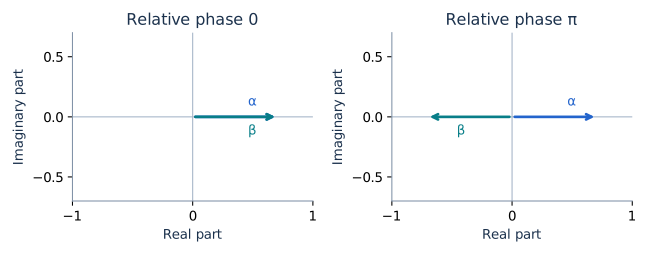
Two amplitudes and sum to one; two amplitudes and sum to zero. Their squared sums are one and zero. Such coherent addition must be implemented by a physical transformation; it is not permission to combine probabilities arbitrarily.
Multiplying an entire ket by a global phase changes no measurement probability:
A phase attached to only one component is relative and can become visible after a basis change. All states have equal Z probabilities; only gives . They occupy different positions around the Bloch sphere’s equator.
2.5 A mixture is not a ket sum
Procedure A prepares every time. Procedure B uses a fair classical coin to prepare either or . Both yield balanced Z results. But A yields X result with certainty, while B yields and equally often.
This is an operational distinction, not an interpretation dispute. Chapter 6 represents B by averaging density operators. Adding kets with classical probabilities would introduce coherence that the preparation did not create.
A state is also not identical to a complete description of the apparatus. The idealized qubit excludes leakage levels, fields controlling the system, and environmental degrees of freedom. We later incorporate their effect using channels. The simple model is useful because its assumptions can be stated and tested.
Laboratory L02 — State preparation. Edit both complex amplitudes. Inspect the raw norm, normalized vector, complex arrows, and probabilities. Compare coefficients , , and . Use different bases to distinguish them.
2.6 Exercises
2.1. Find the conjugate, modulus squared, and reciprocal of .
Show solution / guidance
They are , 25, and . Multiply numerator and denominator by the conjugate to obtain the reciprocal.
2.2. Normalize and calculate Z probabilities.
Show solution / guidance
Each coefficient has modulus squared 5. Divide by ; both probabilities are . Keep the complex phases when changing basis.
2.3. Show that is a normalized orthogonal partner of normalized .
Show solution / guidance
Its norm squared is . Its overlap with the original ket is .
2.4. Compare with , and compare with .
Show solution / guidance
The first is , so only global phase differs. The Y basis pair has overlap and is distinguishable in Y.
2.5. Derive .
Show solution / guidance
Multiply by the conjugate to obtain . It ranges from zero at to one at , modulo .
Further study. An operational, rigorous development of quantum states and measurements is given by Watrous [4].