CHAPTER 07
Bell correlations, teleportation, and dense coding
Learning goals. Derive the CHSH bound, distinguish correlation from signalling, and track the resources and corrections in two communication protocols.
7.1 No-cloning and no-signalling
Suppose a unitary cloned arbitrary states: and likewise for . Preserving the input overlap requires
An overlap strictly between zero and one cannot satisfy this. Thus an unknown arbitrary state cannot be copied perfectly. Orthogonal labels can be copied; the theorem does not prohibit ordinary classical copying [5].
Entanglement also cannot transmit a chosen bit without communication. For a local trace-preserving channel on B with Kraus operators ,
because . A conditioned state at A may depend on B’s result, but A needs B’s classical record to identify that subensemble.
7.2 CHSH from four local answers
Alice chooses setting or , Bob chooses or , and each outputs . In a local hidden-variable model, fix the hidden variable and write predetermined responses . Then
Either or . Exactly one parenthesis is zero and the other is , so the expression is always . Averaging gives
Stochastic local responses can be included in the hidden variable, so the bound remains. The assumptions include independent setting choices and an appropriate separation of local responses; a classical simulation programmed with quantum probabilities is not an experimental test of these assumptions [6, 7].
For and observables , one obtains . Choose :
The joint probabilities are . Summing over t gives , independent of Bob’s setting. Strong correlations coexist with no signalling.
Laboratory L08 — CHSH experiment. Change all four measurement angles, visibility, shots per setting, and seed. Compare exact and sampled correlations and S. Visibility models , not a hardware calibration.
7.3 Teleportation: move a state using shared entanglement
Alice owns input and one half of a Bell pair; Bob owns the other half. Order the wires as input, Alice’s Bell half, Bob’s half. The initial state is
Alice applies CNOT from the input to her Bell half, then H to the input. Grouping by Alice’s two measurement bits gives
Each bracket has norm one, so every two-bit outcome has probability , independent of the input. Bob’s conditioned state is , where a is Alice’s first bit and b her second. He corrects by applying X when , then Z when : the total correction is .
| Alice’s bits ab | Bob before correction | Operations in time order |
|---|---|---|
| 00 | None | |
| 01 | X | |
| 10 | Z | |
| 11 | X, then Z |
For branch 11, . Reversing correction order only adds a branch-global minus sign, but consistent conventions make the derivation transparent.
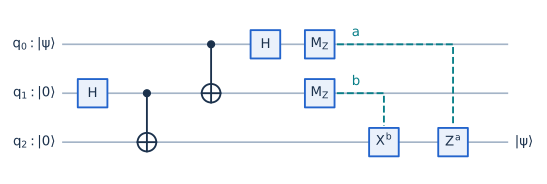
No copy remains at Alice. The protocol consumes shared entanglement and two classical bits. Bob cannot use it for instantaneous messaging: before receiving a and b, his averaged state is . The original protocol is due to Bennett and collaborators [8].
Laboratory L09 — Teleportation. Prepare an arbitrary input, inspect all four branches, disable either correction, and compare the output fidelity with the original state.
7.4 Superdense coding: the complementary resource trade
Alice and Bob first share . Alice encodes two classical bits a,b by applying X when , then Z when to her qubit. This gives four orthogonal Bell states up to phase. She then physically sends her qubit to Bob.
Bob applies CNOT from Alice’s qubit to his, then H to Alice’s qubit. A Z measurement returns ab exactly. One transmitted qubit carries two selected classical bits given an already shared Bell pair. The prior entanglement is a consumed resource; ignoring its distribution would misstate the communication cost [9].
Laboratory L10 — Dense coding. Select a two-bit message, inspect the encoded Bell state, and run the decoding circuit. Compare the sender’s reduced state for all four messages.
7.5 Exercises
7.1. For the noisy Bell model, determine the visibility needed to violate CHSH with optimal angles.
Show solution / guidance
. Violation requires . Failure to violate this particular inequality does not by itself prove separability.
7.2. Why is Alice’s teleportation record independent of ?
Show solution / guidance
Each branch is a unitary image of the normalized input multiplied by , hence has probability . Two classical bits cannot reveal the continuous input amplitudes.
7.3. Teleport and condition on ab=01. Show the correction.
Show solution / guidance
Bob has . Applying X again returns , since .
7.4. Dense-code message 11. Find the encoded state and final output.
Show solution / guidance
X on Alice produces . Z gives . CNOT and H produce up to an irrelevant overall phase.
7.5. Does an arbitrarily large sample of one local half of Bell pairs reveal the distant party’s basis choice?
Show solution / guidance
No. Every local copy has density matrix regardless of a trace-preserving distant operation. Joint records reveal correlations only after communication.